
If you live in Dubai, you’ve probably had this happen at least once. You come home after a long day expecting a cool room, switch on the AC, and within a few minutes you realize something isn’t right. The fan is running, but the room still feels warm.
When customers call us at Dubai Cool Experts, that’s one of the most common complaints we hear. Most people assume the gas has finished or that the whole unit needs replacing. Surprisingly, that’s rarely the real problem.
Over the years we’ve visited homes, apartments, villas, shops, and offices across Dubai. One thing has become very clear: small AC problems almost always give warning signs before they turn into expensive repairs. The trouble is that most people don’t notice those signs until the cooling disappears completely.
Dust Is the Biggest Enemy of Every AC in Dubai
Dubai is an amazing place to live, but the weather isn’t kind to air conditioners.
Even if your windows stay closed most of the time, fine dust still finds its way indoors. Day after day it settles inside the filters, coils, fan, and drainage system. At first, nothing seems different. Then little changes begin.
The room takes longer to cool.
The airflow feels weaker.
The outdoor unit starts making more noise.
The electricity bill slowly climbs.
These things usually happen so gradually that people simply get used to them.

We See the Same Story Again and Again
A few weeks ago we visited a customer who was convinced the compressor had failed. Another company had already suggested replacing major parts.
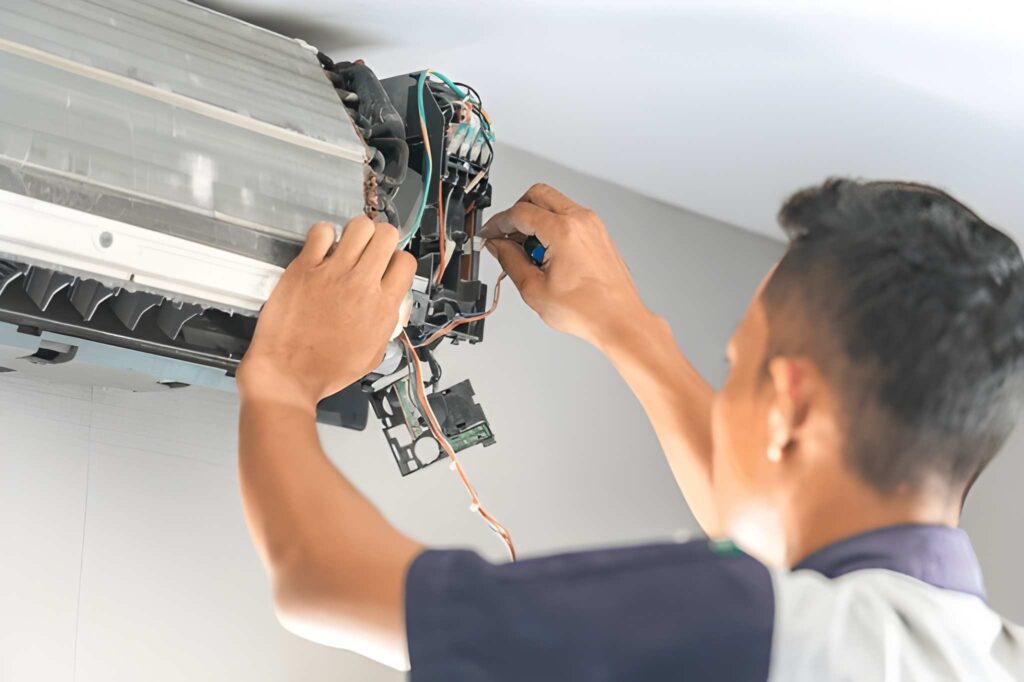
After opening the indoor unit, the problem became obvious.
The filters were packed with dust. The evaporator coil was covered in dirt, and the drain line had started blocking. Once everything was cleaned properly and the system was checked, the cooling came back to normal.
The customer was relieved because what looked like a very expensive repair turned out to be simple maintenance.
Situations like this happen far more often than people realize.
Why Electricity Bills Suddenly Increase
Many homeowners blame DEWA when their monthly bill goes up.
Sometimes the air conditioner is the real reason.
When the system becomes dirty, it has to run longer to reach the temperature you’ve selected. Instead of cooling the room in fifteen minutes, it may need thirty or forty.
That extra running time means more electricity.
Cleaning the system won’t magically cut your bill in half, but it often improves efficiency enough that customers notice the difference over the following months.
Don’t Ignore Water Dripping Indoors
Water leaking from an indoor AC unit always worries people.
The first question is usually, “Is my AC broken?”
Not necessarily.
Most of the time, the drainage pipe is simply blocked with dust, dirt, or algae. Water has nowhere to go, so it starts overflowing inside the house.
If the leak is ignored for several days, it can stain ceilings, damage paint, ruin wooden furniture, and even affect electrical fittings nearby.
A simple cleaning is much cheaper than repairing water damage.
Is It Really Low Gas?
One of the biggest misunderstandings we hear is this:
“My AC isn’t cooling. Just fill the gas.”
Actually, refrigerant doesn’t disappear like petrol in a car.
If the gas level is low, there’s usually a leak somewhere in the system.
Adding more gas without finding that leak is only a temporary fix. After a while, the cooling becomes weak again, and the customer ends up paying twice for the same problem.
That’s why a proper inspection always comes first.
Strange Sounds Mean Something Is Changing
Every AC makes a normal operating sound.
If you suddenly hear rattling, grinding, buzzing, or loud vibration, something has changed.
Sometimes it’s just a loose screw.
Sometimes it’s a worn motor bearing.
Occasionally it’s a fan blade touching another part.
Whatever the reason, unusual sounds shouldn’t be ignored. Small mechanical issues often become much larger if the system keeps running.
Regular Maintenance Isn’t About Selling a Service
Some people think maintenance is just another way for companies to make money.
We look at it differently.
Routine servicing gives technicians the chance to spot problems while they’re still small.
A loose electrical connection can be tightened.
A blocked drain can be cleaned.
Dirty coils can be washed.
Weak airflow can be restored.
Doing these jobs early usually costs much less than waiting until a major component fails during the hottest week of summer.
How Often Should an AC Be Serviced?
There’s no single answer because every property is different.
An apart..ment with little dust may need less attention than a villa close to construction work or a busy road.
Leave A Comment